Padel courts have recently gained significant popularity, making the construction of a padel court one of the most sought-after investment projects in Kuwait. With increasing demand, many investors are eager to capitalize on the sport’s rapid growth, especially as it encourages Kuwaiti youth to engage in physical activities. Learn more about how to build a padel court, its required dimensions, and its cost.
Sakan Real Estate provides essential information about real estate investment, whether for sale or rent, and highlights the advantages of different real estate units. If you’re looking for properties for sale in Kuwait or apartments for sale in Kuwait in various neighborhoods, the platform offers comprehensive details.
What is Padel?
Padel gained widespread recognition in the late 1960s in Europe, particularly in the United States, Spain, Finland, and Argentina. The sport saw its first World Championship in the Middle East in 2021, organized by the Qatar Squash and Tennis Federation. More than 320 male and female players from 16 different countries participated in this championship.
What is a Padel Court?
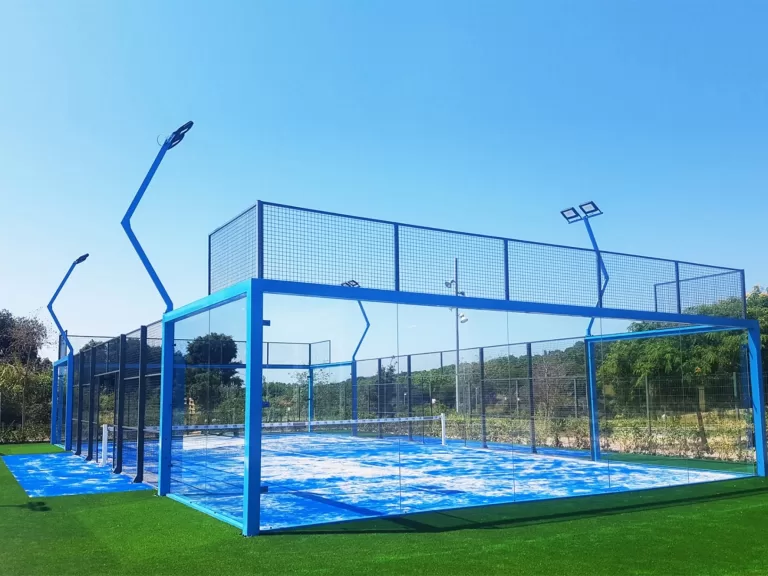
A padel court resembles a tennis court but is significantly smaller and enclosed with glass walls, allowing the ball to bounce off them, similar to squash. The court is divided by a net, and players can utilize the walls as part of their gameplay.
What are the Dimensions of a Padel Court?
- Court Length: 20 meters
- Court Width: 10 meters
- Net Height: 88 cm in the center, 92 cm at the sides
- Back Wall Height: 4 meters
- Side Walls: Half of the sidewalls are 4 meters high, while the other half is 3 meters
Padel Court Surface
The court surface is usually made of artificial turf specifically designed for sports, but other materials like concrete or synthetic sports flooring can also be used. The surface must be non-slip to ensure player safety.
What is the Cost of a Padel Court?
Padel court rental prices vary depending on location and facilities:
- Hourly rental fees range between 10 and 50 Kuwaiti Dinars, depending on the court’s location and amenities.
Key Features of Padel
- Suitable for all ages: The game does not require significant physical strength, making it accessible to a wide range of players.
- Glass walls: These allow for more flexibility and strategic gameplay as the ball can bounce off them.
Why is Padel Called Padel?
Padel originated nearly 50 years ago in Mexico, before expanding throughout Europe, particularly in Spain. It is now ranked second in popularity after football and has surpassed tennis in some countries. The name “padel” derives from the paddle-shaped racket used in the game.
Padel Court Specifications
With the increasing number of padel courts in Kuwait, it’s essential to learn about different residential areas, their advantages, and real estate options like apartments for rent in Kuwait or chalets for sale in Kuwait.
Padel courts are significantly smaller than tennis courts and have a unique structure:
- Doubles courts measure 20 meters in length and 10 meters in width.
- Singles courts measure 20 meters in length and 6 meters in width.
- The court is surrounded by glass walls that are approximately 4 meters high.
- Floodlights are installed at a height of about 6 meters.
- Outdoor courts are preferred, with no minimum ceiling height, although an 8-meter height is recommended.
- The surface should be smooth and level to ensure fair gameplay.
- A solid foundation, such as asphalt, concrete, or crushed stone with sand, must be laid before installing artificial grass.
- The artificial turf should be durable, wear-resistant, and preferably made of polyethylene.
- 8 to 12 kilograms of sand is spread over the artificial turf to keep it in place and provide stability.
- A wire mesh fence is installed above the glass walls, extending up to 4 meters.
- A net is positioned at the center of the court, standing 88 cm high in the middle and 92 cm at the sides.
What is the Proper Planning for Building a Padel Club?
To build a successful and unique padel court, it must offer high-end additional services to attract as many visitors as possible to Kuwait.
- A side gym facility can be added without excessive charges, making it accessible to a wider range of visitors.
- One of the key factors is ensuring the ceiling height exceeds the standard measurements, as professional padel players require higher ceilings for strategic high shots.
- Outdoor courts are preferable to indoor ones due to the noise generated during padel matches.
- Acoustic wall materials can be used to minimize noise transmission outside the court.
- Choosing the right colors is crucial for attracting visitors. Gray is a preferred color, while black is generally avoided.
- Lighting should be well-planned to distribute brightness evenly across the entire court.
How Much Does It Cost to Build a Padel Court?
The cost of constructing a padel court in Kuwait city depends on various factors:
- Court size and location
- Available facilities and services
- Quality of materials and construction standards
- Type of artificial grass and its durability
- Glass panel thickness and strength
- Lighting quality and additional equipment
The final cost can vary based on these factors and the level of interior finishing used in the court.
Padel Court Licensing
There are several regulations to follow when obtaining a padel court license:
- Adhering to the specified court dimensions
- Providing proof of land ownership and settling all related financial obligations
- Complying with the approved height regulations
- Obtaining approval from the country’s Youth and Sports Authority
- Ensuring safety and quality standards are met
Challenges of Building a Padel Court
Building a padel court comes with several challenges:
- Delays in material shipments from global manufacturers
- High land costs and limited availability
- Government restrictions on indoor padel courts
- Complex procedures for obtaining licenses
How Many Padel Courts Are There in Kuwait?
Kuwait has several Padel Blue courts, located in Shuwaikh, comprising seven courts. These courts operate under one-year renewable partnerships for clients and bank employees, based on previously announced schedules.
If you are interested in real estate investments in Kuwait, explore houses for sale in Salwa and apartments for rent in Hawally for various residential and business opportunities.
How Many Sets Are Played in Padel?
A padel match consists of three main sets, with each set comprising six games.
- In doubles matches, the team that wins two out of three sets is declared the winner.
- If the score reaches 6-6, a tiebreaker set is played, and the first team to reach 7 points with a two-point lead wins.
- If the tie persists, an additional set is played to determine the winner.
What is the Capacity of a Padel Court?
A padel match is always played in doubles format (2 vs. 2), meaning the maximum number of players on the court at any time is four.
The official padel court dimensions are:
- Length: 20 meters
- Width: 10 meters
- Minimum fence height: 3-4 meters
This compact size makes a padel court about one-third the size of a tennis court, encouraging faster gameplay and greater player interaction due to the close proximity.
What Are the Rules of Padel?
- The match starts with a coin toss to determine which team serves first.
- The first team to score 6 points wins the set.
- A point is awarded to the opposing team in the following cases:
- The ball bounces twice before being returned.
- A player hits the ball into their own teammate or misses the shot.
- The ball hits the wire fence or any object before passing the net into the opponent’s side.
- The match consists of three sets, with the winner being the first team to win two sets.
What is the Difference Between Padel and Tennis?
The main differences between padel and tennis lie in the court, equipment, and gameplay rules.
| Feature | Padel | Tennis |
|---|---|---|
| Court Size | Smaller, enclosed with glass walls, allowing rebounds | Larger, open court with no walls |
| Racket | Shorter, solid paddle with holes | Longer, with strings for power shots |
| Ball | Similar in size but less pressurized, leading to slower bounces | More pressurized, bounces higher and faster |
| Players | Always played in doubles (2 vs. 2) | Can be singles (1 vs. 1) or doubles (2 vs. 2) |
| Gameplay | Wall rebounds are allowed, requiring more tactics | Ball must remain within open court boundaries |
| Speed & Style | Emphasizes strategy, teamwork, and short-range play | Focuses on power, endurance, and long-range play |
| Learning Curve | Easier for beginners, more accessible | Requires greater physical fitness and advanced technique |
Padel is an easier, more social, and tactical sport, whereas tennis demands greater physical endurance and skill. Both games have their unique appeal, but padel has grown rapidly due to its accessibility and engaging gameplay.
By understanding the history of padel, the process of building a court, and the required dimensions, investors can take advantage of this booming industry.For more insights on real estate investments in Kuwait, explore apartments for rent in Capital Governorate and apartments for rent in Ahmadi.
ChatGPT said:
[sc_fs_faq html=”true” headline=”h3″ img=”” question=”What are the requirements for padel courts?” img_alt=”” css_class=””]Court dimensions:
- Width: 10 meters
- Length: 20 meters
- A clearance of at least 0.5 meters must be maintained on each side, making the total court dimensions 11×21 meters (231 square meters).
- Height: For indoor or covered courts, the ceiling must be at least 6 meters high.[/sc_fs_faq]
[sc_fs_faq html=”true” headline=”h3″ img=”” question=”How many players are there in padel?” img_alt=”” css_class=””]Padel is usually played by 4 players, with two teams consisting of two players each (doubles).
Although padel can sometimes be played one-on-one (singles), the doubles format is the most common and officially recognized in professional tournaments.[/sc_fs_faq]
[sc_fs_faq html=”true” headline=”h3″ img=”” question=”How long is a football field?” img_alt=”” css_class=””]
A professional football field is 105 meters long and 68 meters wide, making the total playing area 7,140 square meters.While these dimensions are preferred for professional fields, FIFA regulations allow some variations:
- Field length can range from 90 to 120 meters
- Field width can range from 45 to 90 meters
However, the 68×105 meters size is the most commonly used in international and professional matches[/sc_fs_faq]